
Last updated November 18, 2026
 AC repair
 Furnace & heating
 Heat pumps
 Ductless mini splits
 Carrier
 Trane
 Goodman
Seasonal tune-up and full diagnostic on your Carrier, Trane, or Goodman system - readings shown to you before any repair is proposed
Diagnosis first, numbers second - you approve the repair price before a single part goes in.
Get your free estimateHow Long Does Air Quality & Ventilation Take? Timelines and What to Expect
A customer once called us expecting a one-hour fix for dusty air blowing out of the vents. What we found was a collapsed flex duct section 40 feet into the attic. That’s a four-hour job minimum, and no honest tech knows that until they’ve actually looked. Most homeowners are surprised by how long air quality and ventilation work takes because they’re quoting the job without knowing whether the problem is at the register, in the duct run, or at the equipment. Each one is a different scope of work entirely. This guide breaks down realistic timelines by job type, why diagnosis often runs longer than the fix, and how Spring Valley homes change the math.
Quick Answer
Simple air quality work like a filter swap takes 15 to 30 minutes. A duct inspection runs 45 minutes to an hour and a half. Full ventilation balancing with duct sealing typically takes two to six hours. UV or filtration equipment installs run one to three hours depending on whether the equipment is going in an accessible closet or a cramped attic. Diagnosis time often runs longer than the repair itself, and in Spring Valley attic conditions add real hours to any job that requires ductwork access.
Styles & brands we work with
- AC repair
- Furnace & heating
- Heat pumps
- Ductless mini splits
- Carrier
- Trane
- Goodman
Table of Contents
- Time Breakdown by Job Type
- Why Diagnosis Takes Longer Than the Fix
- What Spring Valley Access Conditions Add to Timelines
- How to Plan Your Day Around an Appointment
- Red Flags That a Quoted Timeline Is Too Short
- What a Rushed Job Looks Like Six Months Later
- Common Mistakes to Avoid
- Frequently Asked Questions
Time Breakdown by Job Type
Air quality and ventilation isn’t one trade. It’s a stack of separate tasks, and they range from minutes to most of a day. Here’s what we’ve seen across thousands of Spring Valley appointments, from the older homes near the 95 corridor to newer construction up in the hills.
| Job | Typical Time | What Drives the Range |
|---|---|---|
| Filter swap (1″ or 4″) | 15 – 30 min | Filter location, return grille type |
| Filter swap (media cabinet) | 20 – 40 min | Cabinet size, fit |
| Duct inspection (visual + camera) | 45 – 90 min | Attic vs. crawlspace access, system size |
| Duct sealing (partial) | 2 – 4 hours | Number of leak points, access |
| Duct sealing (whole home) | 4 – 8 hours | Square footage, attic layout |
| Ventilation balancing | 3 – 6 hours | Number of zones, damper access |
| UV light install | 1 – 2 hours | Placement, electrical access |
| Whole-home filtration install | 2 – 4 hours | Cabinet retrofit, filter depth |
| ERV / HRV install | 4 – 8 hours | Duct run routing, wall penetration |
Those are the working hours once the tech is on-site and past the door. Add diagnosis time. Add setup and cleanup. On a full duct sealing or ERV job, plan on the whole day being gone. This isn’t padding. It’s the reality of getting into attics that run 130 degrees in July and crawling through 18-inch joist bays in houses built in the 1970s.
Why Diagnosis Takes Longer Than the Fix
Here’s a thing that throws homeowners. The fix takes 20 minutes. Finding the fix takes 50. That’s not a scam. That’s how air quality work actually goes.
Dust, humidity, stale air, musty smells, uneven temperatures – those are symptoms that can come from at least half a dozen places. A cracked return plenum. A disconnected flex run buried behind drywall. An undersized return. A dirty evaporator coil. A failed damper. Bad bath fan venting. You can’t look at one register and guess. You have to test.
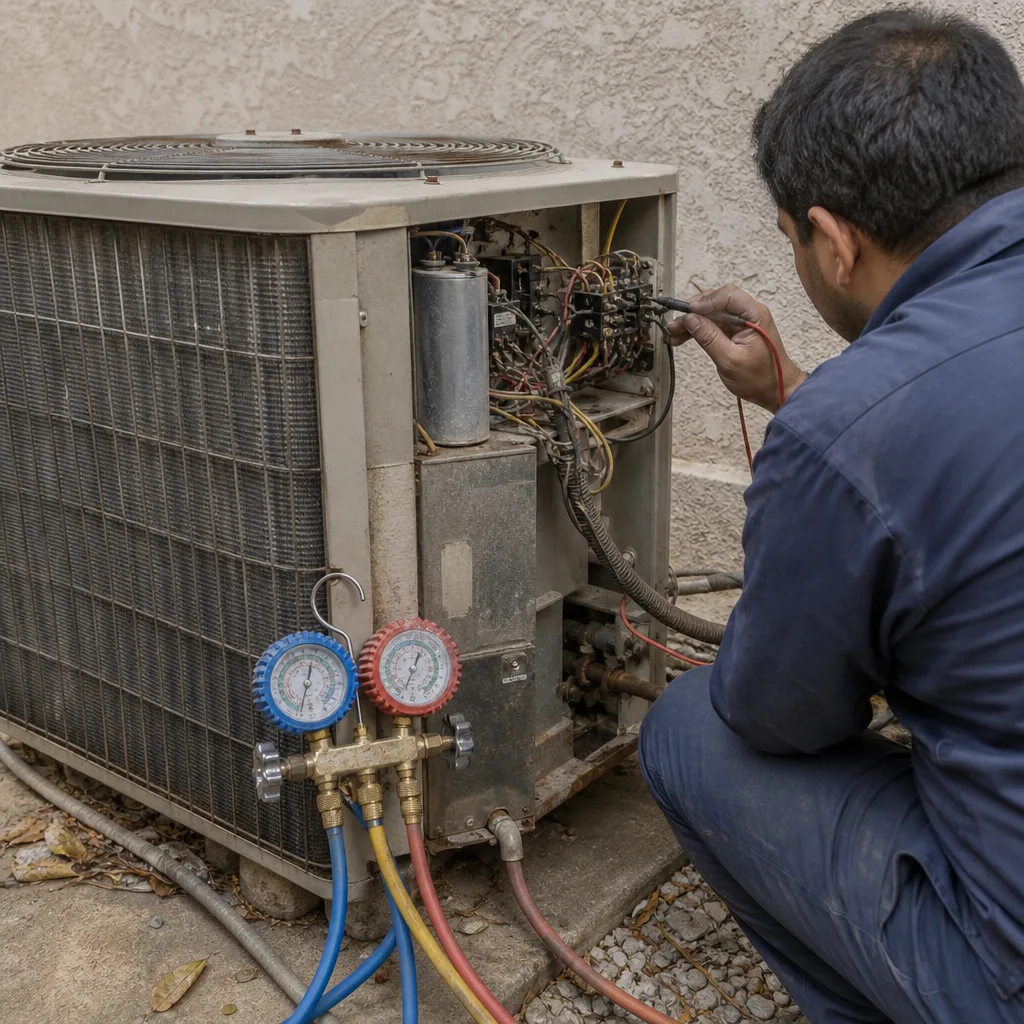
What a real diagnostic looks like:
- Walk the whole system. Every register, every return, the air handler, the attic or crawlspace.
- Measure static pressure at the air handler with a manometer.
- Check temperature split across the coil to see if airflow is restricted.
- Run a smoke pencil or tissue at each register to check supply and return balance.
- Camera the duct runs where they’re hidden or questionable.
- Look for gaps, tears, disconnected sections, crushed flex.
That sequence takes 40 to 90 minutes depending on the size of the home. It’s also the reason we can tell you what’s wrong before we tell you what it costs. Readings first, numbers second. If a company quotes you a fix in two minutes over the phone without looking, they’re guessing. Guessing on air quality is how you end up paying twice.
Even the simplest furnace or AC issue gets checked methodically – that’s the same discipline that carries over from AC repair and installation in Spring Valley. Nobody should say the word “compressor” until the capacitor has been tested.
What Spring Valley Access Conditions Add to Timelines
Timelines quoted from a book assume a clean install with easy access. Spring Valley homes rarely cooperate. Here’s what we routinely run into:
- Attic temperatures. Summer attic temps in Spring Valley regularly push 140 degrees. Any job that requires more than 15 minutes in the attic gets broken into segments with cool-downs. A duct sealing job that would take three hours in a comfortable space can stretch to four and a half.
- Older construction. Homes built in the 1970s and 1980s often have ductwork routed through tight joist bays with no service access. Adding an access panel takes time before the actual work starts.
- Low-pitch roofs and shallow attics. Some of the older neighborhoods have attics you can’t stand up in. Crawling on knees for 40 feet changes the pace of everything.
- Crawlspace duct runs. Homes with crawlspace ductwork mean working at floor level, often in 12 to 18 inches of clearance. Every joint takes longer to reach.
- Desert dust and debris. Spring Valley’s dust gets into everything. Duct cleaning jobs here pull more material than in wetter climates, which adds time to bagging and disposal.
- Flex duct that’s been crushed or rerouted. We see a lot of DIY duct repairs. Straightening out someone else’s work adds hours.
The dry climate works in our favor on one thing: we don’t have mold growth in ducts the way coastal climates do. But the dust and the attic heat are real. When we quote a timeline in Spring Valley, we build in the heat breaks and the access work. That’s why our numbers sometimes run longer than a national quote by phone. Ours are honest.
How to Plan Your Day Around an Appointment
You shouldn’t have to burn a whole vacation day for an air quality visit. Here’s how to structure it.
- Ask upfront how long the visit will run. A real estimate includes diagnosis plus repair time. If they say “thirty minutes,” ask if that includes looking at the ducts.
- Book a first-slot appointment. The earliest slot in the day tends to run on time. Afternoon appointments can slip when morning jobs run long.
- Work from home if you can. Most of the visit is in the attic or mechanical closet. You can be on calls while the tech is working.
- Have someone home for the first hour. That’s when the diagnostic conversation happens. After that, you can leave the tech to the work.
- Ask for the findings before the repair. We show readings and numbers before any work begins. Air quality work isn’t emergency work most of the time, so you can decide on the fix without pressure.
- Keep a notepad. Air quality conversations get technical. Write down what they tell you about filter size, duct condition, and what to check monthly.
Nothing about this work is same-day urgent the way a dead AC in July is. We can plan air quality appointments around your schedule, and there’s a free second opinion on any written estimate if you want one before you commit.
Red Flags That a Quoted Timeline Is Too Short
When a quote over the phone promises something unrealistic, it usually means one of two things: they don’t know what they’re walking into, or they’re planning to cut corners. Either way, you pay for it later.
- “Full duct cleaning in one hour.” Duct cleaning on a typical Spring Valley three-bedroom runs two to four hours. One hour means equipment being run, not ducts being cleaned.
- “Ventilation balancing in thirty minutes.” Balancing means measuring every register and adjusting dampers. Thirty minutes is a measurement, not a balance.
- “We’ll quote the whole job over the phone.” Without duct photos or access inspection, no one knows if the run is intact. The quote will go up at the door.
- “A filter swap will fix the dust.” If the problem is a torn supply plenum or a disconnected return, a filter won’t touch it. Filters catch what gets to the filter. They don’t fix leaks downstream.
- “No need to go in the attic.” Almost every real air quality issue in a Spring Valley home has a duct component. Anyone who skips the attic isn’t doing the diagnostic.
- “We’ll just seal the system with mastic.” Mastic sealing has to happen at the leak points. If they don’t identify those first, they’re smearing paste on the easy-to-reach joints and calling it done.
What a Rushed Job Looks Like Six Months Later
Rushed air quality work fails quietly. You don’t see it for months. Then you notice the dust is back, or the upstairs stays warm, or the humidistat reads 60 percent in a house that should read 40.
Common patterns after a rushed job:
- Duct tape that’s peeled off. Regular duct tape fails in Spring Valley heat. Proper sealing uses mastic or UL-181 rated foil tape. If they used gray tape and it’s lifting by fall, the seal was rushed.
- Disconnected flex under insulation. Flex duct can look connected through the insulation sleeve while the inner liner is separated. You don’t find out until next summer’s electric bill.
- UV lights placed where they can’t reach the coil. UV works on the coil surface. A rushed install puts the bulb where it’s easy to mount, not where it does the job.
- Filter cabinets installed with a leaky gasket. If the door doesn’t seal, dust bypasses the filter entirely. Six months later, the evaporator coil is dirty and cooling is down.
- Balancing done by eyeball. If nobody measured with a flow hood or manometer, it wasn’t balanced. It was guessed.
This is where the 90-Day Done Right Promise matters. If we miss something – a disconnected run, a poorly sealed joint – one call brings the fix without an argument about whether it was covered. We know that on a rushed air quality job, the failure comes later, not during the visit.
Common Mistakes to Avoid
- Judging the job by the phone quote. The on-site number will always differ once someone actually crawls the attic. That’s not a bait-and-switch. That’s what happens when the real problem isn’t in the room you’re standing in.
- Assuming the filter is the problem. Dust in a Spring Valley home often traces back to a return leak in the attic or a plenum crack near the air handler. A high-MERV filter swapped on schedule won’t stop dust that enters downstream of the filter.
- Letting the timeline drive the diagnostic. If you push a technician to hit a two-hour window they never had, corners get cut at the sealing and balancing stage. Those cuts fail in six months.
- Choosing a high-MERV filter without asking about static pressure. A 4″ MERV 13 in a system designed for a 1″ MERV 8 can choke airflow. That makes the home dustier, not cleaner, because the system runs longer and pulls less air.
- Skipping the attic inspection because the register looks fine. Every air quality issue we’ve seen in Spring Valley that wasn’t fixed the first time had a duct problem no one climbed up to look at.
- Hiring someone with no verifiable address or license. If the number that shows up on the truck isn’t the number that answers the phone, the rush call to fix a rushed job a year later is often your only option.
- Not asking what “clean” means. Air quality isn’t a service category with a universal standard. Ask what the tech will measure before and after. If they can’t describe the before-and-after readings, they aren’t measuring anything.
See the difference
 Before
 After
 Before
 After
 Before
 After
When to Call a Professional
Filter swaps and register dusting you can do yourself. Beyond that, most air quality work crosses into territory where the fix goes wrong quietly if it isn’t measured. Call a pro if you’re seeing dust reappearing within days of a filter change, if any room stays warmer or cooler than the rest of the house no matter what the thermostat says, if a musty smell shows up in one room or a closet, if the AC drains slowly or the evaporator coil frosts up, or if you’re considering a UV or whole-home filtration install and want to know whether your duct layout will support it. Duct sealing and ventilation balancing always require a pro – those involve testing equipment and attic work that isn’t a weekend project.
Ray’s Heating & Air Spring Valley offers free estimates in Spring Valley – call (833) 620-7288. Phones are answered by a live person around the clock, and there’s a free second opinion on any written estimate if you’ve got one in hand already.
Frequently Asked Questions
Most Spring Valley air quality visits run between 90 minutes and half a day. A quick filter and inspection visit is usually 45 to 60 minutes. A full diagnostic with duct camera work runs 90 minutes to two hours. Full ventilation balancing or duct sealing typically takes a full day. The biggest variable is whether duct access is straightforward or requires working through tight attic heat and older construction.
Sometimes, but not always, and honesty here matters. A filter issue or a simple gasket fix can often be resolved on the diagnostic visit. A collapsed flex duct 40 feet into the attic or a torn plenum requires a scheduled return with the right parts. Ask for the findings before committing to a same-day repair. If the fix is a filter swap, it’s a same-day fix. If it’s a duct run, it’s a scheduled job.
Attics in Spring Valley routinely hit 130 to 140 degrees in summer, which means any technician working up there has to break the job into segments with cool-downs for safety. Older homes also have shallow attics and tight joist bays that force crawl-speed work. A duct sealing job that takes three hours in a comfortable space routinely runs four to five hours here. Any honest quote in Spring Valley builds that in.
These are three different scopes at three different price and time points. A filter swap replaces the filter media in the return grille or media cabinet, done in 15 to 30 minutes. A duct inspection is a visual and camera inspection of the duct system to find leaks, disconnects, and crushed sections, done in 45 to 90 minutes. Ventilation balancing is adjusting dampers and sealing leaks so every room gets the airflow the system was designed to deliver, done in three to six hours. A filter swap treats strain. A duct inspection finds the source. Balancing fixes the source.
It depends on the system age and the diagnosis. If the equipment is 15 years or older and the ducts are in poor shape, sometimes a coordinated replacement and duct upgrade saves more long-term than piecemeal fixes. If the equipment is younger and running well, fixing the duct system is usually the better move. For heat pump or mini-split replacement timelines, see heat pump and mini split in Spring Valley. For furnace-side air quality interactions, heating and furnace in Spring Valley covers how filter and return sizing affect heat delivery.
It varies widely by scope. Filter swaps are inexpensive. Duct sealing typically lands in the low four figures depending on square footage and access. UV and whole-home filtration installs land in the mid hundreds to low thousands installed. We quote after diagnosis, not before – that way the number matches the actual problem. There’s no trip charge inside the county and no overtime charge for after-hours calls. Call (833) 620-7288 for a free estimate.
The Bottom Line
Air quality and ventilation work takes as long as the actual problem requires, not as long as a phone quote suggests. A filter swap runs 15 to 30 minutes. A diagnostic runs 45 to 90 minutes. Duct sealing and ventilation balancing run most of a day. Spring Valley attic heat, older construction, and dense desert dust push every timeline longer than a flat-rate book would suggest, and rushing the diagnostic is how this work fails six months later. The right question isn’t “how fast can you do it” – it’s “will the person doing it measure before they fix.” Readings first, numbers second. That’s the standard worth holding a company to.
If you’re in Spring Valley and wondering why the dust keeps coming back, give us a ring. You’ll get a real person on the phone, a scheduled visit, and a measurement of what’s actually happening in your ducts. And when you’re looking around for other local guidance, the Ray’s Heating & Air Spring Valley home page is a good place to see the full range of what we handle.
Ray’s Heating & Air Spring Valley is locally owned and owner-operated, backed by the 90-Day Done Right Promise in writing on every heating and cooling job. We service all major brands, including Bryant, American Standard, Carrier, and Trane. Background-checked technicians with continuity – same face next visit, not a rotating cast. Upfront pricing with readings shown before any work begins. Call (833) 620-7288 for a free estimate and to schedule your air quality and ventilation diagnostic.
Written by the team at Ray’s Heating & Air Spring Valley.