
Last updated November 18, 2026
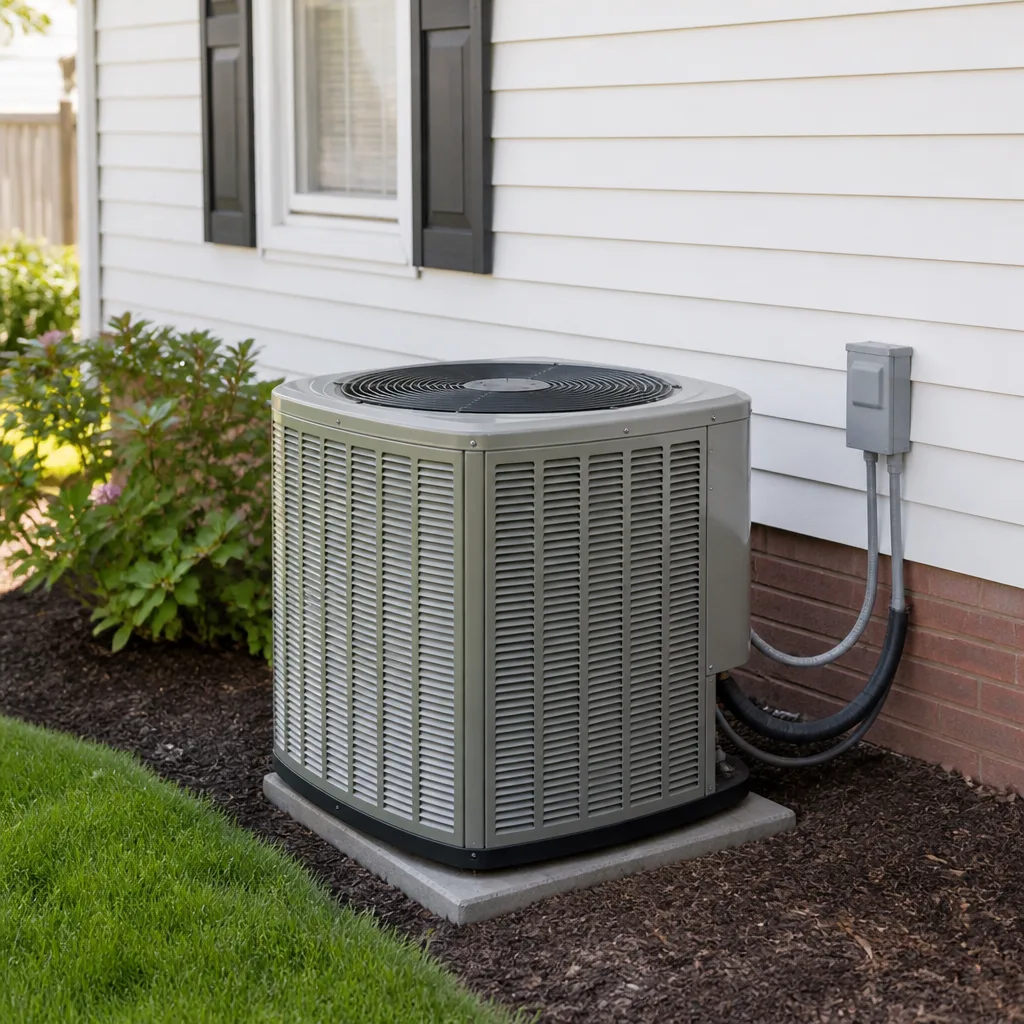 AC repair
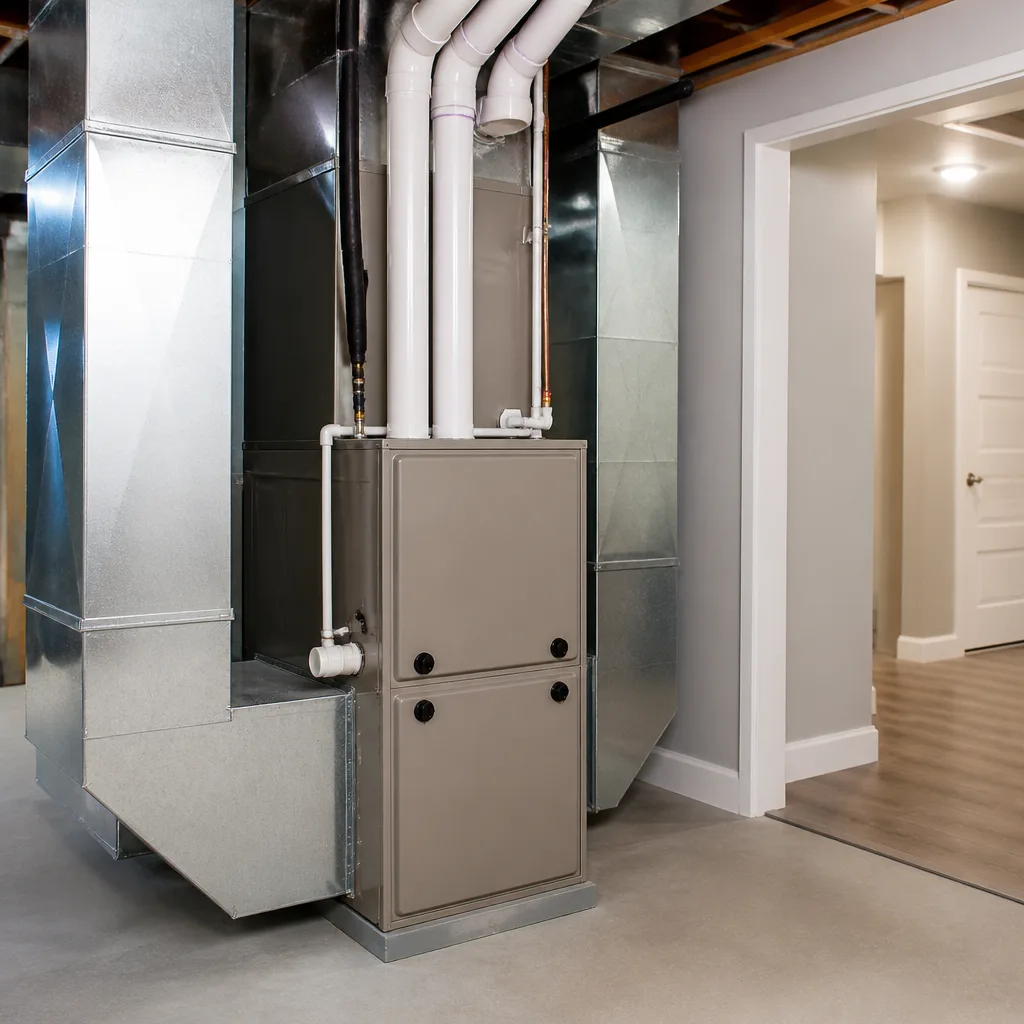 Furnace & heating
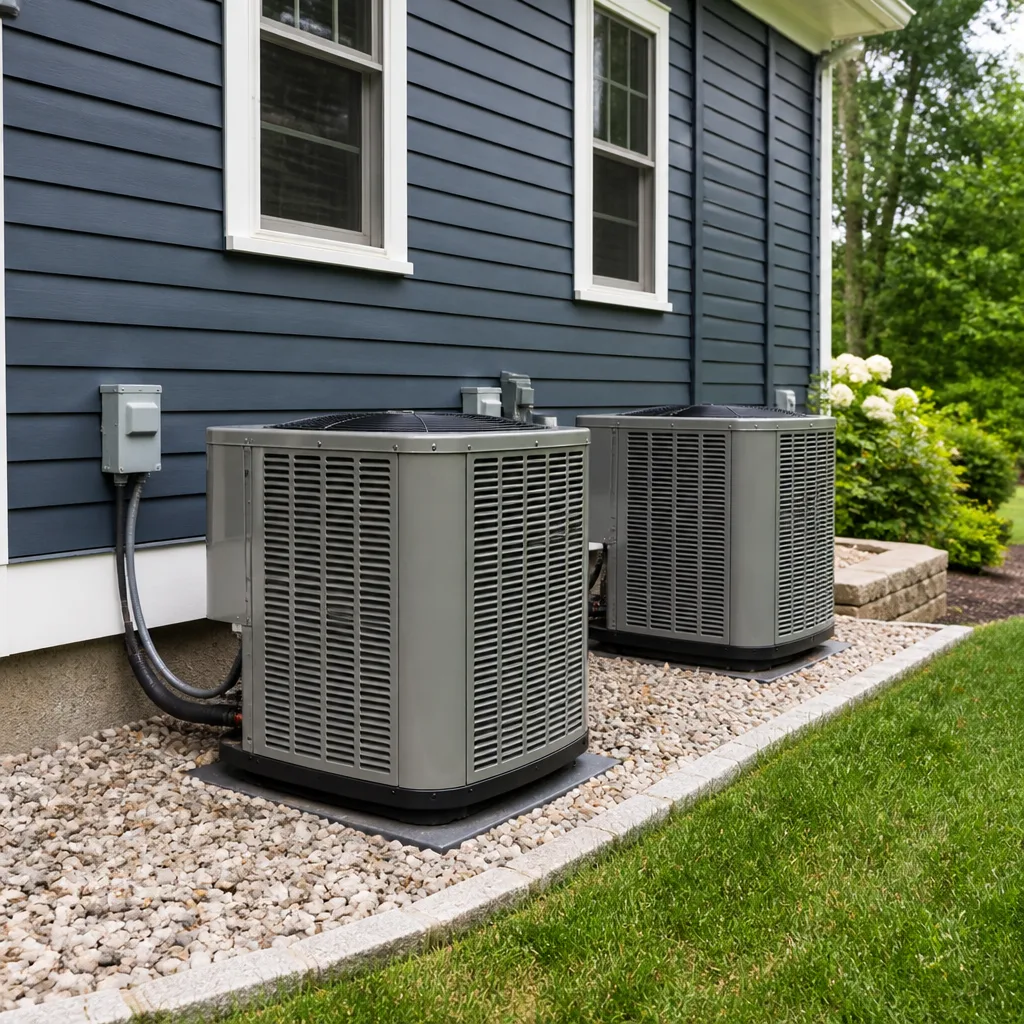 Heat pumps
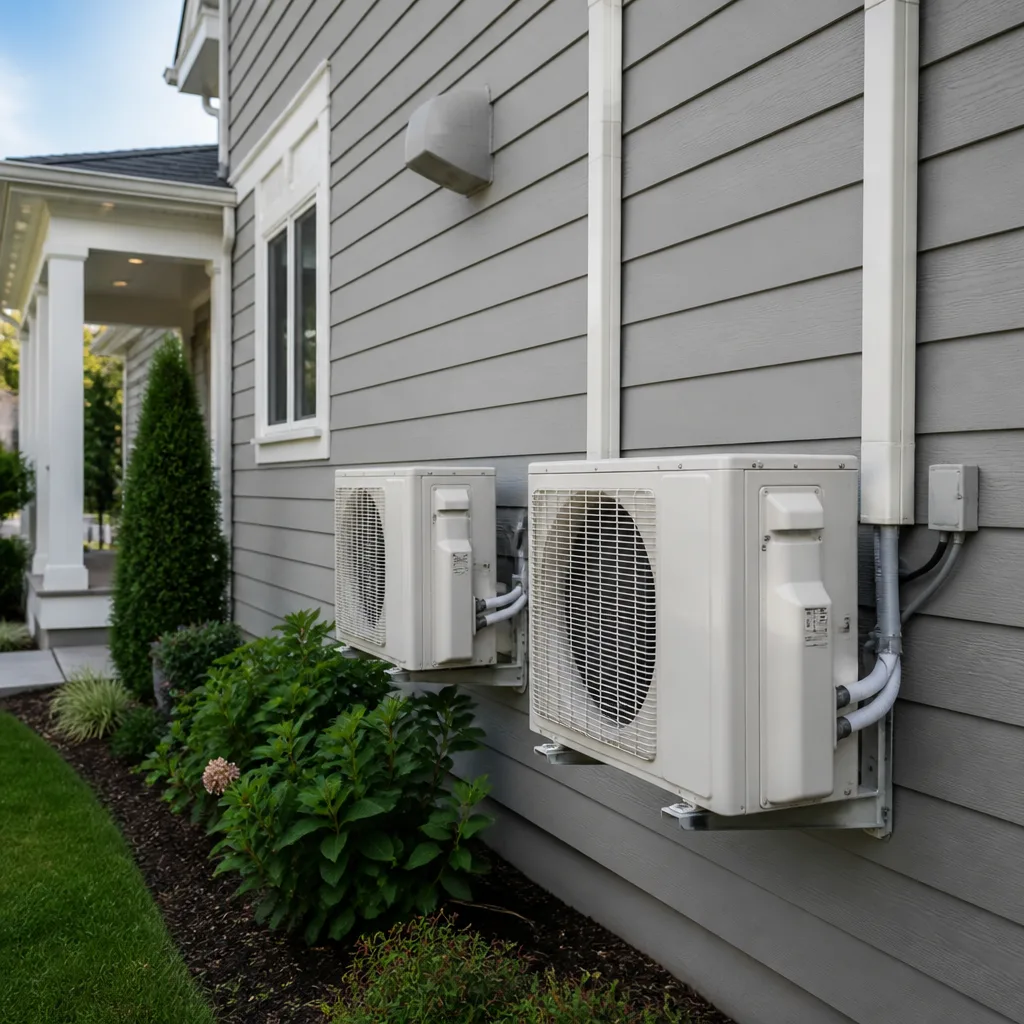 Ductless mini splits
 Carrier
 Trane
 Goodman
Seasonal tune-up and full diagnostic on your Carrier, Trane, or Goodman system - readings shown to you before any repair is proposed
Diagnosis first, numbers second - you approve the repair price before a single part goes in.
Get your free estimateDIY vs Professional Emergency & Commercial HVAC: What’s Safe to Do Yourself
One of the worst things you can do when your AC quits at 9 PM in July is watch a refrigerant recharge video on YouTube and try to handle it yourself. R-410A under pressure can cause frostbite. And if that wasn’t the problem, you’ve just made a diagnosis harder. We’ve answered enough panic calls in Spring Valley to know the pattern: the homeowner who tried one thing too many usually ends up paying for the damage on top of the original repair. This guide sorts out what’s actually safe to touch yourself during an HVAC emergency, what’s illegal to touch in Nevada, and how to tell when an after-hours call is worth the rate. It also covers the commercial side, where the stakes and the codes get stricter.
Quick Answer
During an HVAC emergency, safe DIY steps are limited to things that use no tools and touch no refrigerant or line voltage: check the breaker, check the thermostat, change or check the filter, clear debris from the outdoor unit, and make sure the system switch is on. Anything involving refrigerant, compressors, wiring, gas piping, or opening an electrical panel needs a licensed professional. In Nevada, refrigerant handling requires EPA Section 608 certification, and electrical work generally requires a licensed electrician. Everything else waits for a trained technician or creates a problem that costs more than the original breakdown.
Styles & brands we work with
- AC repair
- Furnace & heating
- Heat pumps
- Ductless mini splits
- Carrier
- Trane
- Goodman
Table of Contents
- The Safe DIY Emergency Steps, in the Order to Try Them
- Three “Fixes” That Look DIY but Come With Real Risk
- How to Cool a Home During an Emergency Without Injury or Damage
- Temporary Fixes That Are Fine vs Temporary Fixes That Mask a Problem
- Is an After-Hours Emergency Call Worth the Rate?
- Commercial HVAC: Where DIY Stops Entirely
- Common Mistakes to Avoid
- Frequently Asked Questions
The Safe DIY Emergency Steps, in the Order to Try Them
If your system quits, start here and work down the list. In our experience, roughly half of the “emergency” calls we run in Spring Valley turn out to be something on this list – a tripped breaker, a thermostat in the wrong mode, a filter that hasn’t been changed since last summer. None of these steps require a tool beyond a screwdriver, and none of them can hurt you or the equipment.
- Check the thermostat first. Make sure it’s set to cooling and the fan is on “auto” or “on.” Check that the batteries aren’t dead and that the display is actually lit. In the newer Spring Valley subdivisions, we regularly see digital thermostats drop into a factory reset after a brownout, and the system sits there doing nothing.
- Check the breaker at the panel. Look for a tripped breaker in the main panel and the outdoor disconnect. If it trips again after you reset it, stop. Repeated tripping is a symptom, not a cause.
- Check the filter. A clogged filter can freeze a coil or choke airflow until the system shuts down on a safety. Pull it and hold it to the light. If you can’t see through it, replace it.
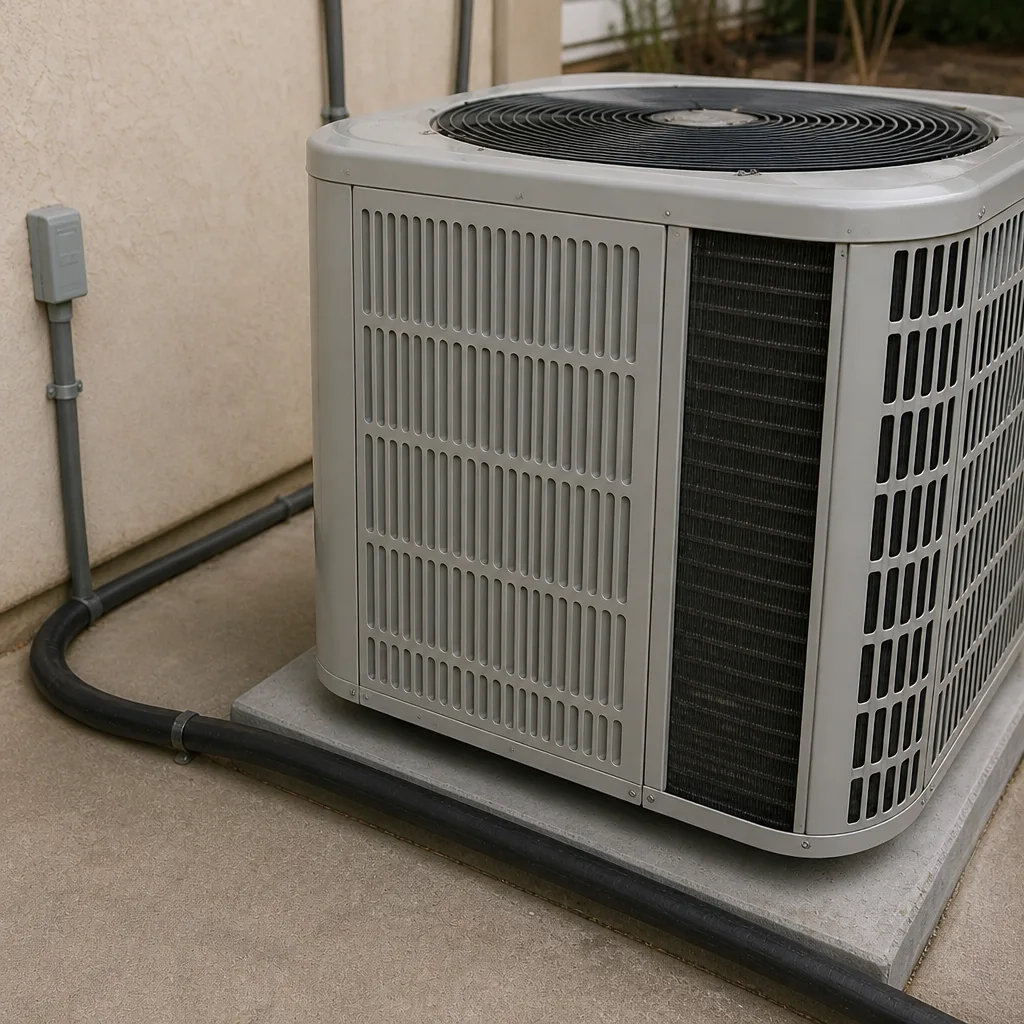
- Look at the outdoor unit. Clear away leaves, grass clippings, and anything stacked against the unit. The condenser needs airflow to dump heat.
- Check the float switch on the drain line. A plugged condensate line will trip the float and shut the system off. If you can find the switch, check whether it’s tripped.
- Check the service switch on the indoor unit and the outdoor disconnect. Sometimes a switch gets bumped during cleaning or a power surge.
If none of that brings the system back, stop troubleshooting and call. That’s where Ray’s Heating & Air Spring Valley home comes in, and it’s also where the risk of a DIY diagnosis goes up. We’d rather answer a quick question than fix a busted compressor.
Three “Fixes” That Look DIY but Come With Real Risk
Here’s where a lot of homeowners get into trouble. These three look simple on a video, and they aren’t.
1. Adding refrigerant
Adding refrigerant requires EPA Section 608 certification under federal law. Handling R-410A or R-454B without training can cause frostbite and eye injury, and venting refrigerant to atmosphere is illegal. More importantly, adding refrigerant without diagnosing the leak is like adding oil to a car that’s burning it – you haven’t fixed anything. The charge may already be correct, and now the next technician has to figure out what the previous reading actually was. In Spring Valley, a system that loses charge in June usually has a leak that’s been there since March.
2. Electrical work at the panel or the contactor
Opening the electrical panel or replacing a capacitor, contactor, or transformer requires line-voltage safety work that generally requires a licensed electrician in Nevada, and in practice it belongs to someone trained for HVAC electrical. A capacitor holds a charge long after the power is off. We’ve seen a homeowner’s “simple” capacitor swap turn into a blown control board and a $600 bill because of a miswired terminal. If the person at your door hasn’t tested the capacitor before saying the word compressor, that’s a red flag; testing is part of real diagnostics.
3. Bypassing a safety switch
The float switch, high-limit switch, and pressure switch are there for a reason. Running a jumper wire to defeat a float switch keeps the system alive, but it also lets water pool and eventually reach the ceiling or subfloor. In the older Spring Valley homes with evaporator coils in the attic or the worst crawl space, that bypass has caused more water damage than the HVAC failure ever would have.
How to Cool a Home During an Emergency Without Injury or Damage
You don’t have to sit and sweat while you wait. There are real, safe ways to keep a home livable, especially in the triple-digit stretches that hit Spring Valley in July and August. The trick is doing them in a way that doesn’t stress the equipment further or put anyone at risk, especially older homeowners or anyone with health issues where the heat is a genuine danger, not just a discomfort.
- Close the blinds on the west and south sides. Radiant heat through glass is often the single biggest indoor load in the afternoon.
- Use box fans and ceiling fans to move air. A fan doesn’t lower the air temperature, but it moves heat off skin. Keep windows closed and fan air moving inside.
- Run the system on fan-only if the fan still works. Continuous fan circulation keeps air moving and pulls some humidity out, even without cooling.
- Open windows and doors at night if the overnight low drops below 75. Much of Spring Valley does cool off enough overnight to take advantage of this.
- Keep interior doors open. Closed doors can pressurize a room and reduce airflow through the returns.
- Take a cool shower or use a damp cloth on the neck and wrists. The old methods work.
What you should not do is run a “DIY swamp cooler” with an open cooler full of ice in front of a fan. It adds humidity, and in a valley home with a tight envelope, that humidity can feed moisture problems and warp flooring. The same goes for propping the outdoor unit door open to “let it breathe” – that’s not how a condenser works.
Temporary Fixes That Are Fine vs Temporary Fixes That Mask a Problem
Some temporary fixes really are fine. Others quietly make the eventual repair bigger. Here’s how we sort them in our heads when a Spring Valley homeowner tells us what they tried.
Fixes that are fine temporarily
- Changing a filter a few days early.
- Resetting a breaker once, if it holds.
- Clearing debris off the condenser coil.
- Replacing thermostat batteries.
- Clearing a slow-draining condensate line with a shop vac from the outside (not by cutting into a glued line).
- Using a portable AC unit or window unit short-term to hold one room.
Fixes that mask a problem
- Jumping the float switch. You’re trading a system shutdown for water damage.
- Rising the thermostat set point to “get by.” If you set it to 82 and the system still runs constantly, you have a capacity problem that won’t fix itself.
- Topping off refrigerant “just to get through the week.” You’re paying for refrigerant that will leak out again, and the leak hasn’t been found.
- Putting tape over a frozen suction line or adding insulation. Ice on the line means low airflow or low charge. Tape fixes neither.
- Tightening electrical connections by feel. Loose or over-torqued connections cause fires.
The pattern is simple: if a “fix” makes a warning light go away without fixing the underlying condition, it isn’t a fix, it’s a delay. And in Spring Valley, delays are expensive when the next 108-degree day arrives.
Is an After-Hours Emergency Call Worth the Rate?
Sometimes yes. Sometimes the smart move is to ride it out until morning. Here’s how to make the call without a panic decision.
Call now: if there’s a gas smell or a burning smell anywhere near the equipment, if you see water actively leaking into the ceiling or a living space, if the outdoor unit is making a loud mechanical noise or the breaker won’t stay reset, if the indoor temperature is climbing past 85 and there’s a senior, an infant, or someone with a health condition in the house, or if it’s a commercial space with product or a business that can’t close.
Wait until morning: if the system is cooling weakly but still cooling, if the fan runs but the air is only slightly warm, if the issue is a frozen coil that has time to thaw, or if a single room is warm but the rest of the house is fine. In each of these cases, the “emergency” is really a service call that can wait a few hours, and the morning rate is usually lower than the after-hours rate.
One more thing to consider about Spring Valley weather: if it’s an overnight low of 88 in July and the family can’t sleep, the emergency rate is easier to justify than it is in March when a broken furnace can be covered with a space heater and a sweater for one night. Rain and heat make the decision, not just the clock. If you’re not sure, call us at (833) 620-7288 and we’ll tell you straight whether it can wait.
Commercial HVAC: Where DIY Stops Entirely
On a commercial system – a rooftop package unit, a split system serving a business, a mini-split in a retail space – the rules tighten further. Commercial equipment runs on three-phase power, higher voltages, and controls that tie into fire alarm panels, building management systems, and life safety. Touching any of that as a business owner or employee is not worth the liability, and in many cases your commercial insurance policy won’t cover a claim if unlicensed work caused the damage.
What a business owner can safely do: check the thermostat or building management set points, check the filter, clear the condenser of debris, verify the breaker, and confirm the equipment switch isn’t off. That’s it. Everything past that – refrigerant, electrical, controls, compressors – belongs to a licensed contractor, and the contractor should be able to show licensing and insurance before they touch anything. If a commercial rooftop unit fails and the business can’t operate, that is a genuine emergency, and calling after-hours is the right move; the lost revenue is usually higher than the emergency rate within a few hours. It’s also the fastest way back to a working space, which is what matters most in Spring Valley’s small-business corridor.
If your commercial system needs a repair or a plan for the summer, AC Repair & Installation in Spring Valley covers the residential and light commercial side, and we’ll tell you straight if your situation is better served by a commercial specialist.
Common Mistakes to Avoid
- Watching one video and calling it research. A single YouTube clip won’t show you the voltage on a capacitor, the pressure in a refrigerant line, or the specific code requirements for a Spring Valley home’s electrical panel. It shows the steps, not the risk.
- Adding refrigerant without troubleshooting. You’re masking the real failure and paying for gas that will leak out. We test before we touch the gauges; the person at your door should too.
- Jumping a safety switch to keep the system running. Float switches, high-limit switches, and pressure switches exist to prevent other damage. Defeating one turns a repair into a repair plus a cleanup.
- Resetting a tripped breaker more than once. If it trips again, something is wrong. Reset once, and if it goes again, call.
- Blocking the outdoor unit with plants or fencing. A condenser needs a foot or two of clear air on all sides. In Spring Valley, decorative fencing around the condenser is a common cause of a system that “runs but doesn’t cool.”
- Ignoring a frozen line. Ice on the suction line means low airflow or low charge, and it will not fix itself. Thawing the coil without finding the cause is a delay.
- Doing the work on a commercial system to save a service call. The liability and insurance exposure far outweigh the savings, and the equipment is designed for licensed hands.
For a deeper look at what to expect on the equipment side, Heating & Furnace in Spring Valley and Heat Pump & Mini Split in Spring Valley walk through the repair and install considerations for those systems. If you’re stuck on brands, the equipment we see most in Spring Valley homes – Rheem, York, Daikin, Bryant, and the other major makes – all play by the same rules: routine maintenance is what keeps them out of the emergency column.
See the difference
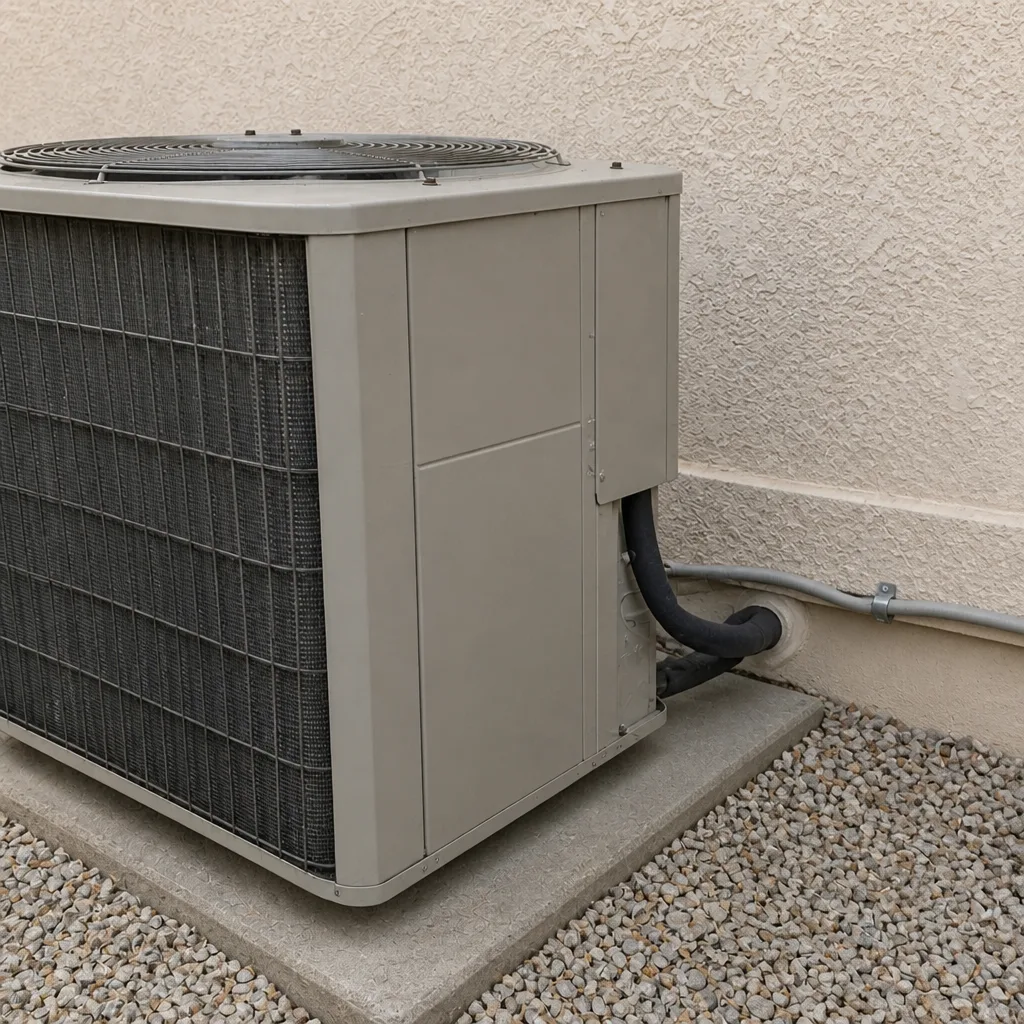
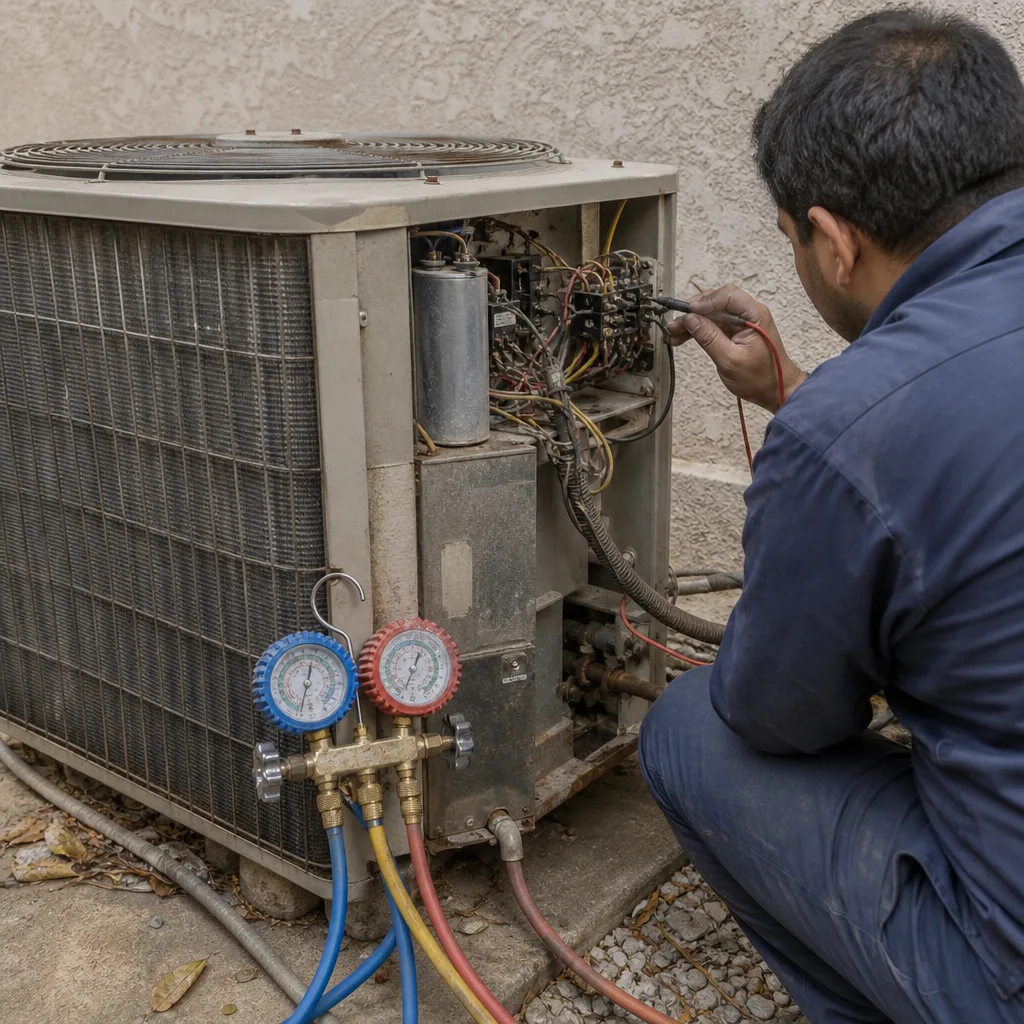 Before
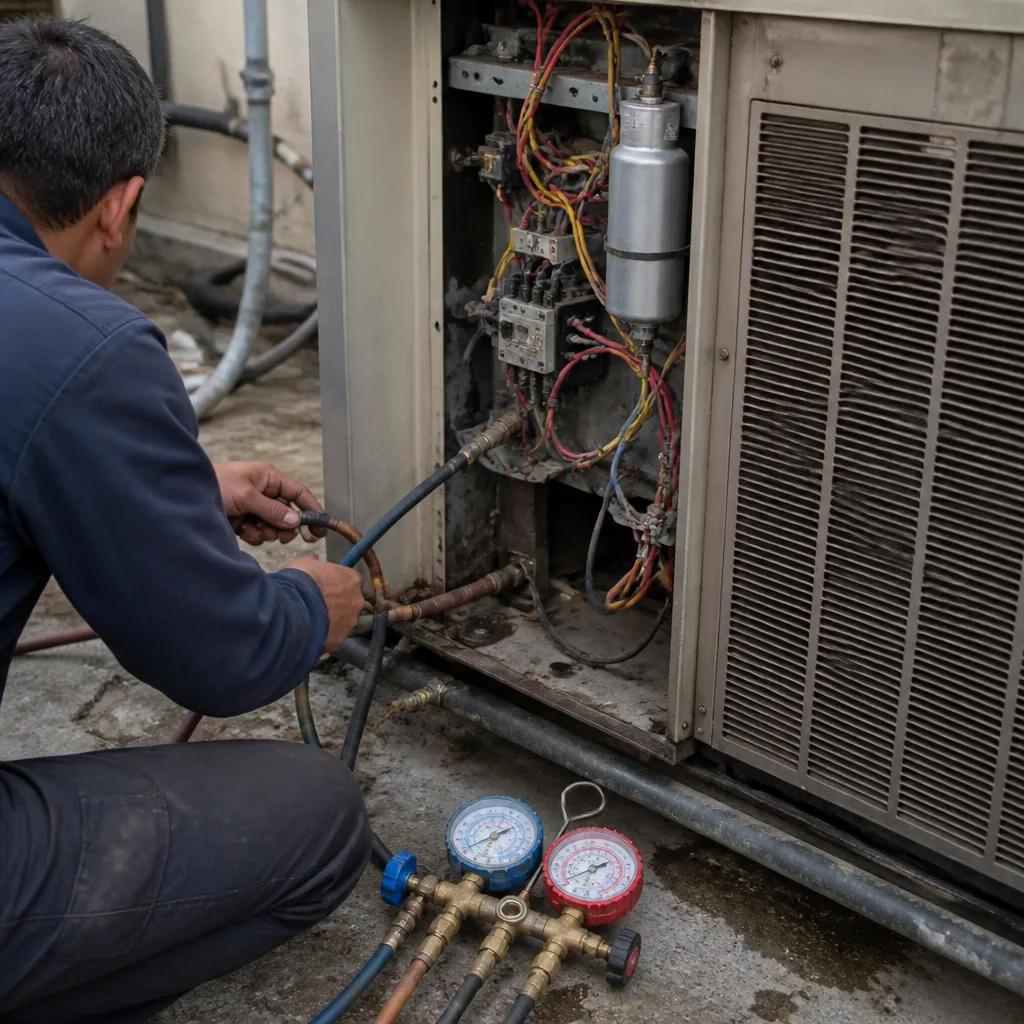
 After
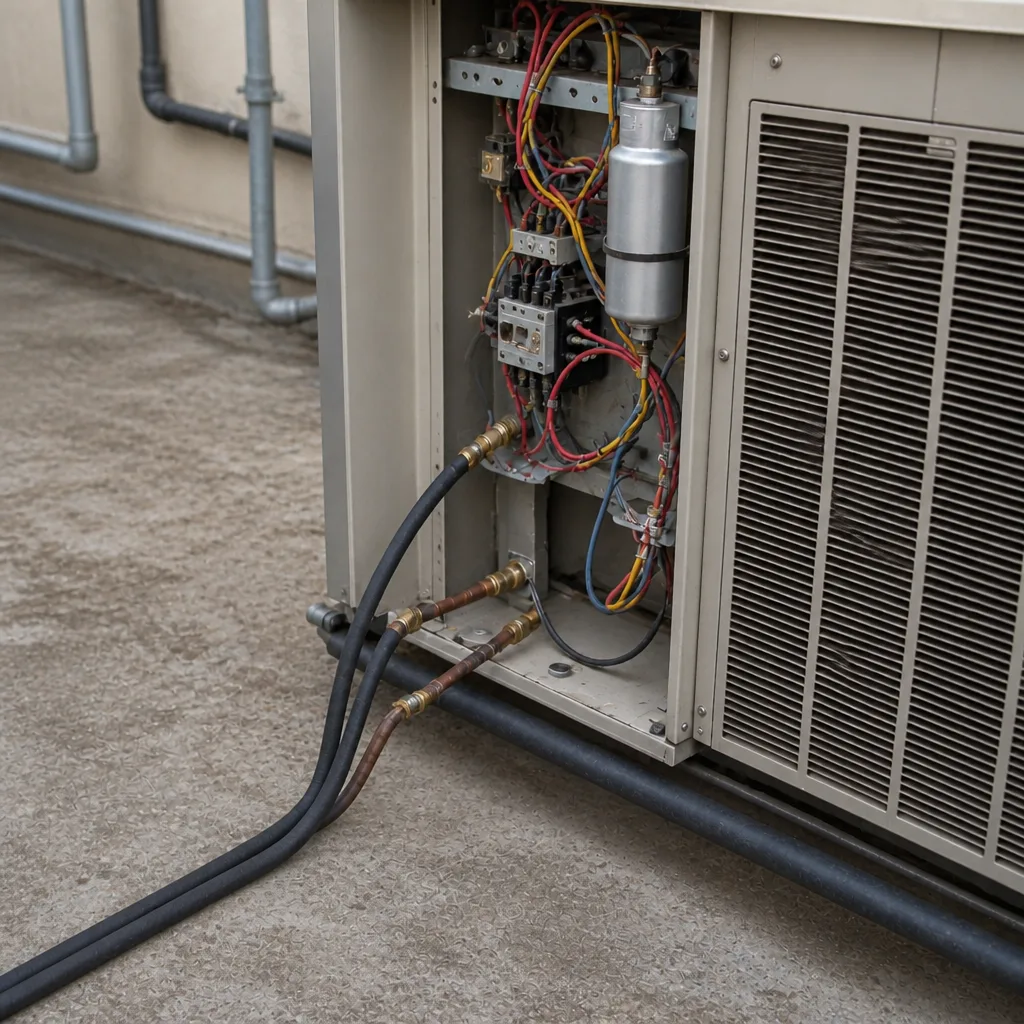
 Before
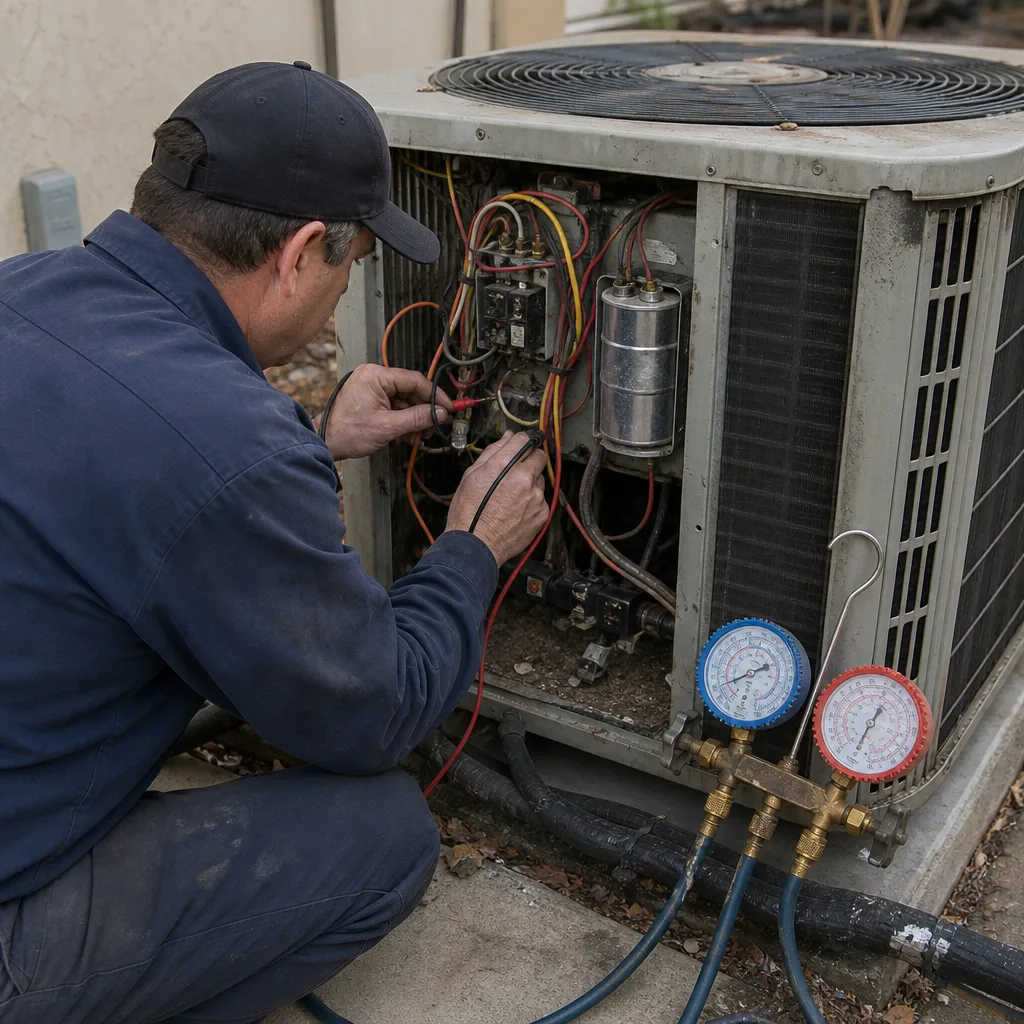
 After
 Before
 After
When to Call a Professional
Call a professional if there is a gas smell, a burning smell, active water leaking from a system, or an outdoor unit making a mechanical noise. Call if the breaker trips more than once, if the system runs but doesn’t cool, if the line is frozen, or if the indoor temperature is climbing while the system runs. On a commercial system, call for any issue past the thermostat and filter. And if you’re just not sure, call and ask. Ray’s Heating & Air Spring Valley offers free estimates in Spring Valley – call (833) 620-7288. Every job carries the 90-Day Done Right Promise: if it isn’t done right, one call brings Ray back to make it right. We test before we quote – you’ll see the readings and the numbers before any work begins, and the person who shows up is the person who finishes.
Frequently Asked Questions
Check the thermostat, then the breaker, then the filter – in that order. Roughly half of the “emergency” calls we run in Spring Valley are one of those three: a thermostat in the wrong mode, a tripped breaker, or a filter that hasn’t been changed. None of those steps require special tools, and none can hurt you or the equipment. If all three check out and the system still won’t cool, call us at (833) 620-7288 for an exact quote; estimates are free.
No. Handling refrigerant legally requires EPA Section 608 certification, and venting refrigerant to atmosphere is illegal. Beyond the law, R-410A and R-454B are under pressure and can cause frostbite and eye injury, and adding refrigerant without finding the leak just delays the failure. Call us for an exact quote – estimates are free.
No. If there’s ice on the suction line or the indoor coil, shut the cooling off and switch to fan-only, but don’t scrape the ice off or keep running the compressor. Frozen lines usually mean low airflow or low charge, and running the system in that state can damage the compressor. Call for a diagnosis – estimates are free.
Close the west- and south-facing blinds, run ceiling and box fans, keep interior doors open, and use window units or portable AC to hold one room if you have them. If the overnight low drops below 75, open windows at night. Avoid DIY “swamp cooler” methods that add humidity to the house. Call (833) 620-7288 for next-step advice or to schedule an exact quote.
It depends on the age of the equipment, the repair cost relative to replacement, refrigerant type, and whether there are two or more expensive repairs in a short window. A system past 12 to 15 years old that needs a compressor or an evaporator coil usually points toward replacement. Call us for a free second opinion on any written estimate before you decide.
Possibly, depending on the equipment and the utility. Federal tax credits and local utility rebates change year to year, and the paperwork is part of what we handle if we do the install. Call (833) 620-7288 and we’ll walk through what’s currently on the table for your address.
The Bottom Line
In an HVAC emergency, the pressure to do something yourself is real, and so is the risk. The safe DIY steps are short: thermostat, breaker, filter, debris, and a visual check. Everything past that – refrigerant, wiring, contactors, compressors, commercial equipment – belongs to someone with the training and the license, and in Nevada, the law agrees. A safe workaround like fans, blinds, and a cooled room can hold a home until morning when the rate is lower. What a homeowner can’t safely do is troubleshoot a system past the point of a switch, and trying to is how a $180 repair becomes a $1,200 repair. If you want the readings and the numbers in front of you before any work begins, call (833) 620-7288 for a free estimate. The person at your door will be the person who finishes the job.
Written by the team at Ray’s Heating & Air Spring Valley.